On October 16, the State Bank of India heard from its threat intelligence provider, the Defense Cyber Agency and CERT-In of a suspected exposure of customer data on the dark web. The bank’s own analysis of the listing found 3,897 records carrying names, phone numbers, email addresses, dates of birth and home addresses. By October 21 it had told the stock exchanges, and it went on to notify those customers one by one and to say their money was safe. Within the week, the cluster of disclosures it landed in was being called Black October in the trade press, and most of what sat under the name was infrastructure: two critical PHP flaws, a certificate authority whose keys could be computed from its own certificates. That part belongs to CISOs.
Five things from that week belong to anyone who runs a login, and a bank’s customer records were only the first. A hosting platform’s list of 321,810 accounts, and keys and stored secrets from developer platforms and one poisoned package. Servers sold for automated trading, with stored passwords, and the brokerage trades that followed. And three US banks, the same week, limiting third-party AI agents’ access to customer accounts, one of them to no login at all. Identifiers and credentials in circulation end at a login page, and you run one.
As of October 30, the one place the week’s stolen passwords have been reported used at customer logins is Japan’s FX brokers, through GMO’s servers. I can find no report from a bank or regulator of a wave against consumer bank logins anywhere else, and the rest of this post is about why that silence is a window, not an all-clear.
The silence is a clock.
What is in circulation, and what I could not confirm
Start with the records. SBI’s 3,897 are names, numbers, emails, birthdates and addresses: the answers a recovery flow asks for, and the fields a lure needs to look personal.
The account list with a timeline is Zeabur’s. By itself, an attacker used leaked internal credentials to access the shared cluster on October 14 and read the platform database on October 15: 321,810 account records and 3,218,965 stored environment variables. Zeabur’s table lists the account data as email, username and phone number, with an “etc.”, and the post says nothing about account passwords. It is here because that timeline runs to the minute, which is why the look-back below has a date.
The keys belong to the fintech and processor reader. Railway’s preliminary report says an intruder read encrypted secrets for at most 1.85 percent of workspaces, decrypted a subset looking for AI provider keys and found no user accounts logged in. LiteLLM’s release 1.107.0 was live on PyPI for about two hours on October 21 carrying malware that steals credentials. PingCAP says stolen service-account credentials gave an intruder access to internal systems from September 9 to October 7, and the exported records include TiDB Cloud user names, email addresses and encrypted API-key values.
Two more are closer to a consumer login than they look. GMO’s Onamae Desktop Cloud, a service sold for automated FX trading, confirmed on October 20 that malware had been installed on up to 26,739 customer servers and told anyone who stored passwords on them to rotate them. By October 27, GMO confirmed that customer data had been published, and OANDA Japan’s own notice said third parties had logged into some customer accounts and traded using ID and password pairs that may have leaked from the service. The next day, Dukascopy Japan confirmed unauthorized trades in the accounts of its customers who used the service. That one is the trading-account case, and the one of the five already passed the login.
The fifth is the opposite case, a credential handed over rather than lost: by October 19 the Financial Times had reported, as carried by Retail Banker International, that Citi, Bank of America and JPMorgan Chase were limiting third-party AI agents’ access to customer accounts. Citi’s statement was that it does not permit third-party AI agents or assistants to log into a customer’s account.
Now what I could not confirm. eMudhra’s eight weak keys led Mozilla to pull one of its roots on October 20, and the fear that followed, forged certificates for banks, has not surfaced as a case in any report I can find. SBI has not said where its records came from. And the Zeabur list has not been reported tried at a login or offered for sale.
All five lead to a login.
The announcement came first
In 2021, F5 Labs published the one measurement I know of for what happens to a spilled credential over time. Five stages, in order.
| Stage | F5’s description |
|---|---|
| 1. Slow and Quiet | Sophisticated attackers use the credentials in stealth mode; the stage usually lasts until they start sharing them |
| 2. Ramp-Up | Use accelerates as the credentials spread; in F5’s words it “only lasts about a month before the credentials are discovered” |
| 3. Blitz | Amateurs rush to use the credentials once the spill is public |
| 4. Drop-Off | Use falls back, still above stage one, as the credentials lose their premium |
| 5. Reincarnation | Attackers repackage the credentials, hoping for a continued lifecycle |
The number that matters sits across the first two rows. Across the spills F5 could date, discovery took 327 days on average and 120 at the median, and the quiet use and the ramp-up ran inside that gap, before anyone knew.
Now the Black October side. Zeabur’s database was read on October 15 and the disclosure came on October 19: four days. Railway’s intruder got in on October 20 and Railway published on October 21: one day. LiteLLM’s poisoned release went up and came down on October 21, with the disclosure the same day.
Two of the five ran nearer F5’s shape. PingCAP’s intruder was inside from September 9 and was found on October 7, 28 days from entry to discovery against F5’s median of 120, with the notice twelve days later. SBI heard about its records on October 16 because they were already listed, and the date they left is not known. For the list, the announcement came first.
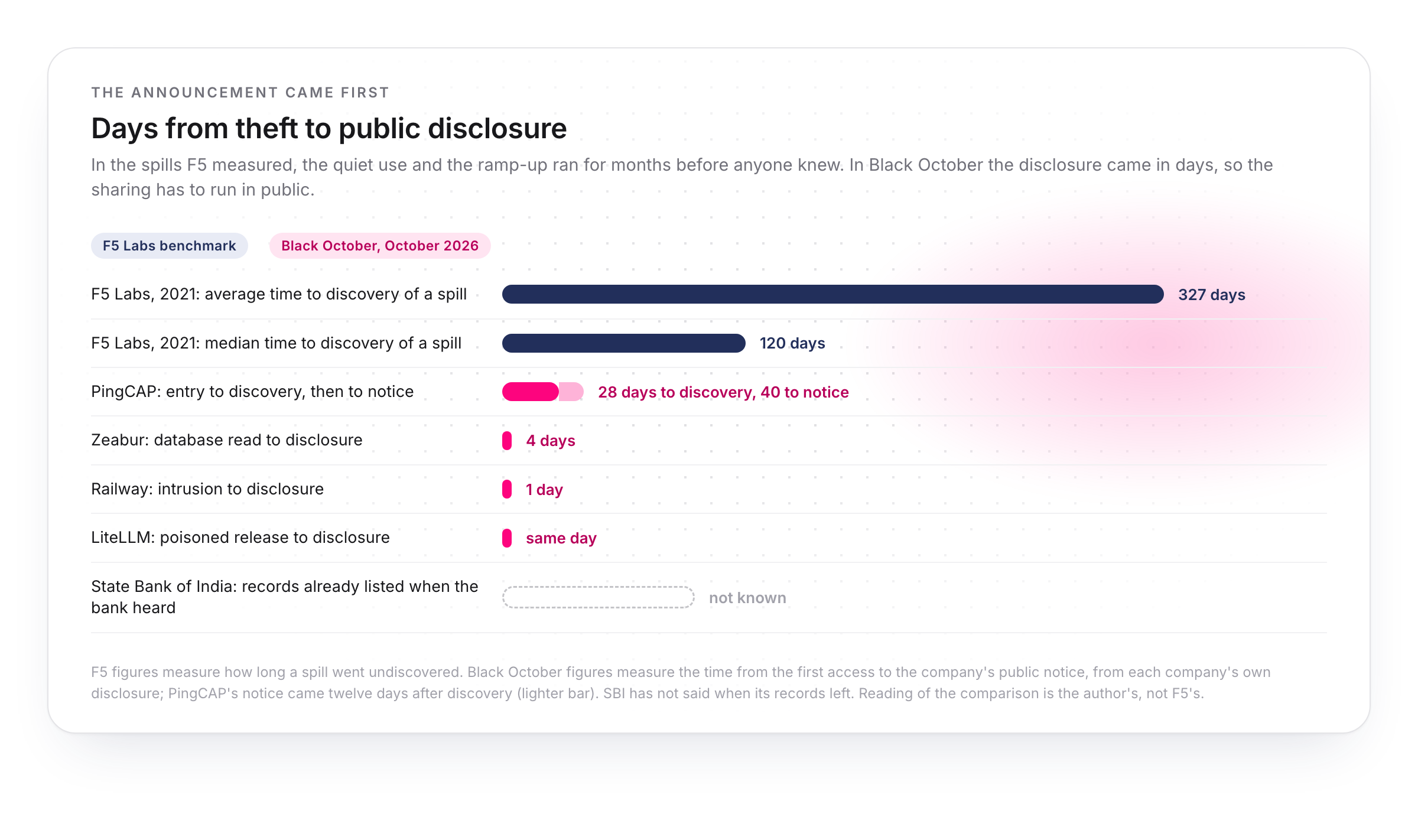
Its quiet phase lasted four days, and the look-back runs from the first of them to today. In F5’s data, the sharing and the ramp-up ran for months before anyone knew; here they have to run in public, which is the other way round from the pattern F5 describes. That is my reading, not F5’s.
The keys were used fast, where they were issued: Wiz saw the AWS credentials taken through LiteLLM being validated about four and a half hours after exfiltration. The stored trading passwords were used inside the week: GMO confirmed the malware on October 20, and by October 27 OANDA Japan had confirmed logins and trades with pairs that may have leaked from the service. The account list is the other story: the only sighting of it I can find is Zeabur’s own disclosure. For once, the defender can know before the list spreads if the defender knows which customers are exposed.
A median of 120 days, down to four.
Where the fork is
Take one email address from the list. It hands an attacker the address, a username and a phone number, and the password has to come from somewhere else.
So the fork is at the join. Run the address against the older spills, the kind F5 measured, and against stealer logs, and either an old password comes back attached to it or nothing does. If one does, it belongs to a developer who, like 48 percent of Americans in Yubico’s 2025 survey, uses the same password on more than one account. Say one of them is a bank.
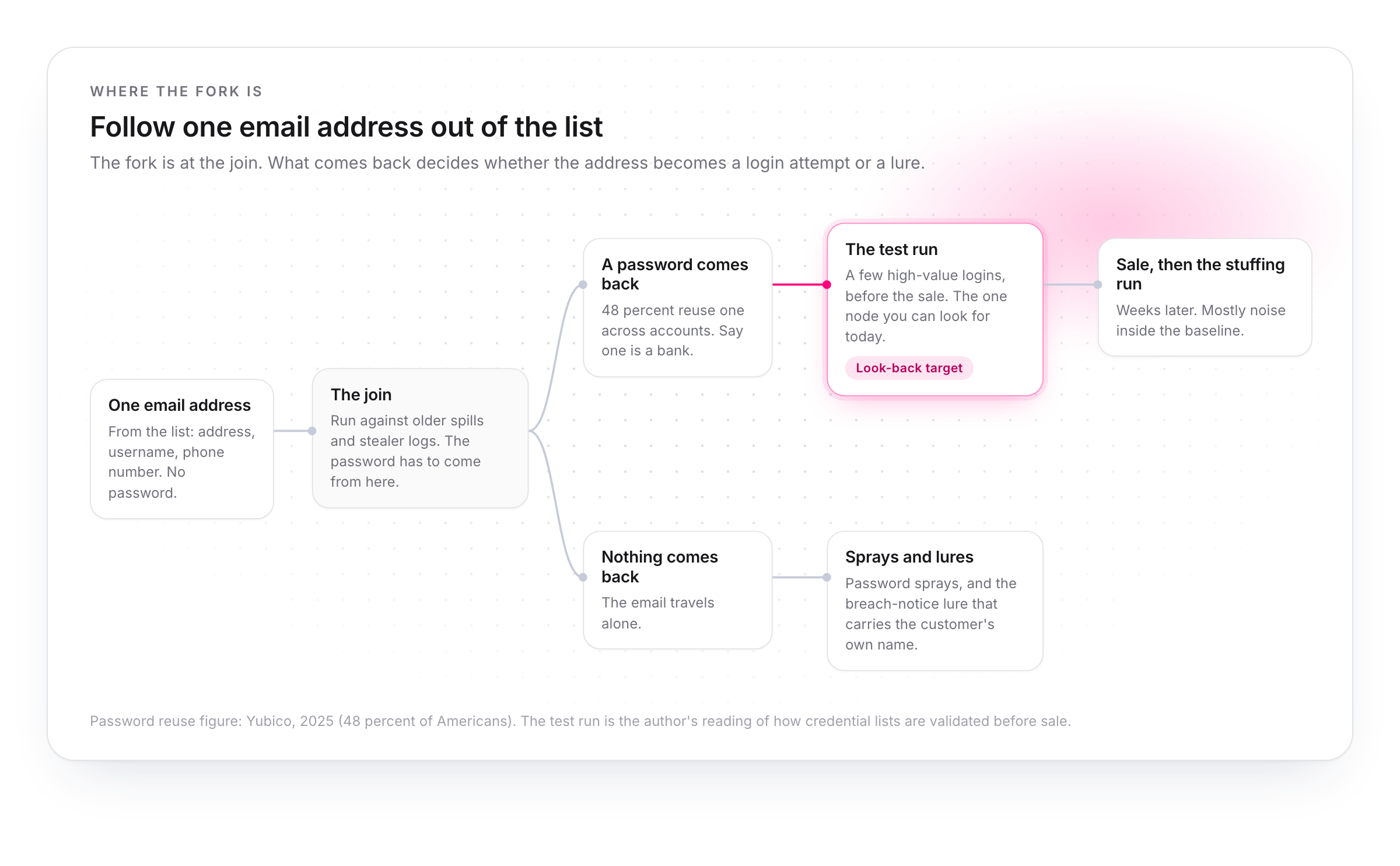
If something comes back, the pair goes where such lists usually go: sorted, then checked against a handful of high-value logins in a small test run, the kind that tends to precede a sale, then packaged with the rest. That run, if it happened, is the one thing you can look for today: from October 15 to now, in logins passed and failed, by account and device. If your login was one of the few, it is there. A clean look-back is a finding too. After the sale comes the stuffing run, and at a regional bank’s login that is mostly noise inside the baseline: match 321,810 developer accounts against your book and expect a handful of hits, not a campaign.
If nothing comes back, the email travels alone, into sprays and into lures.
The pair’s story is small. Here’s the thing. The headline travels further than any list will.
What travels further than the list
A breach in the news tends to become the next lure. The UK’s National Cyber Security Centre said as much after Equifax in 2017, warning that the volume of scam emails often increases after major data breaches, and CISA repeated the warning in its own alert that September.
The shape at a consumer login is the same one. A notice about the week’s breaches arrives by text or email, and with SBI’s kind of record behind it, it carries the customer’s own name and address. The link opens a copy of your login page, and a real customer types a real password. Then comes the part your stack meets: a correct password from a new device, a step-up challenge, and a push on the customer’s screen. The customer, phone to ear with “the security team,” is about to say yes.
The takedown feed saw a URL. The engine sees a correct password from a new device, waiting on the push it sent. The customer is the one thing neither tool is watching.
The tap is still ahead.
Two endings
Ending one is what the stack cannot know yet. The password is right. The device is new, so the score saw it, asked, and was told yes. The money moves.
Ending two starts before the attempt. The bank knew something the score cannot produce on its own: which of its customers had been on the copy of its login page that week. With that, the step-up, the reset and the payee change had an input they did not have in ending one, and the control did what policy already allows: held the new-device push and routed it to a callback, held the payee change for the cooling period.
Valid credentials, unverified intention. The week produced the near case, in Citi’s own policy: a third-party agent logging in with the customer’s credentials is a login the password check accepts, because it is the password, and a push the customer will approve, because they sent the agent. Citi’s line stops at the policy, and the rest is my reading.
The three standard moves still apply: match the lists against your customer base, read failed logins by shape rather than by count, and protect the push with number matching. Four questions for Monday that go past them, each with an owner, and the same four for the app and the API as for the web login:
- Whoever owns the takedown feed: what is watching the copy of our login page, and who is standing on it?
- The identity lead: at a reset or a payee change from an unknown device, what happens when the customer passes the knowledge questions? Is there a per-device limit on resets, and a cooling period before a new device can change a payee?
- The ops manager and customer comms: what does the call center say when a customer asks whether we just called them, and what has every customer heard from us in advance about what we will never ask for on a call?
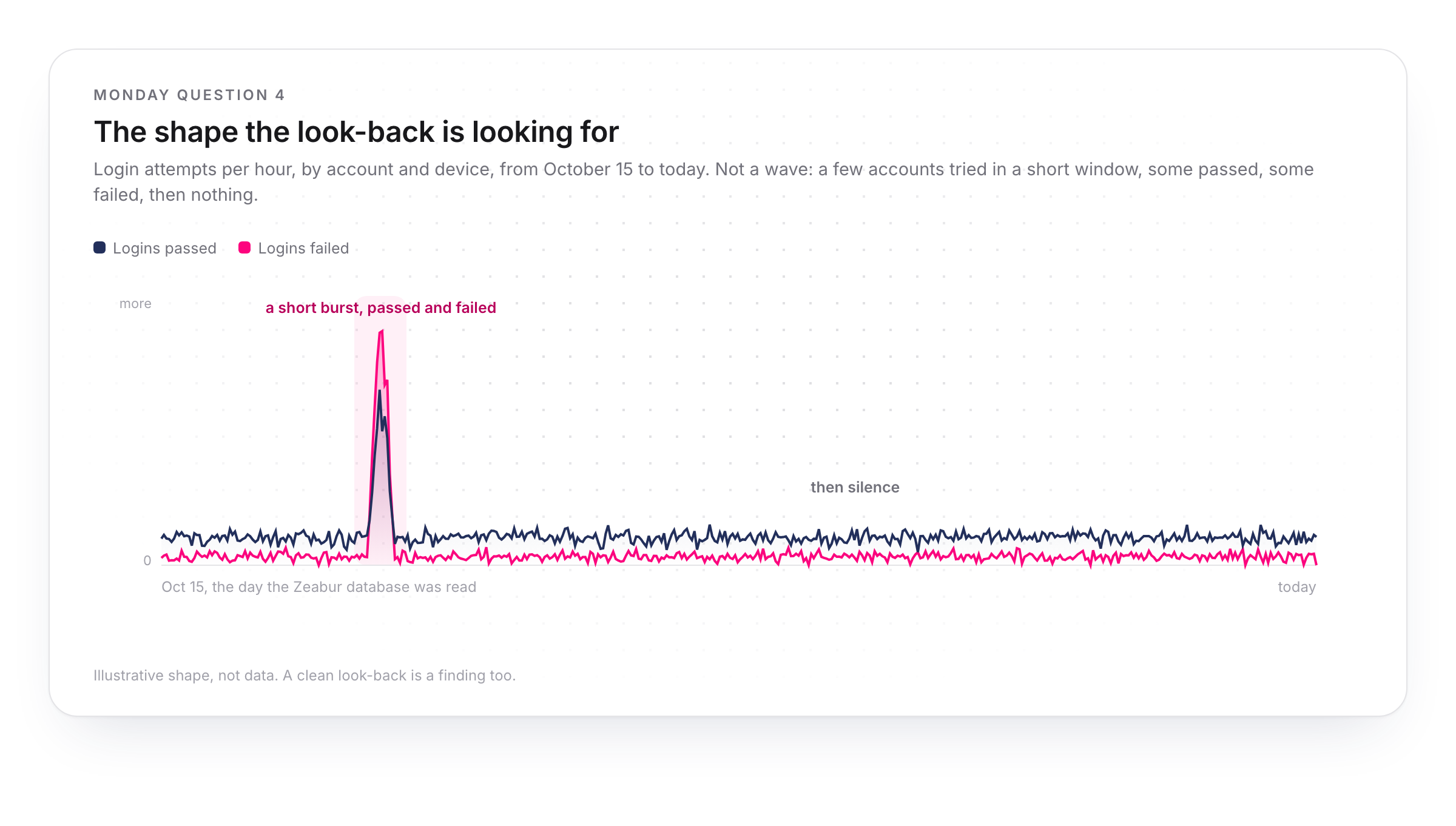
- The ops manager: the look-back, from October 15, the day the Zeabur database was read, to today, in logins passed and failed, by account and device. The shape is a short burst, passed and failed, then silence.
What you knew first decides it.
Where we come in
Memcyco works outside your environment, where the scam forms and your customer meets it, before a control inside sees a signal. For the case this post followed, a copy of your login page, that means one script on your genuine login page and nothing on the customer’s device. On supported copies we can see the copy forming and your customer arrive, and whether credentials were entered, and we name that customer, not the URL, while the site is still up. What the attacker captures on a supported fake form is a marked decoy: useless to them, and when it is tried on your real login the attempt can be recognized and tied to the attack, and the device that tried it is known from then on. That is an observation, this customer, this scam, this device, this time. It reaches your own controls as an alert or as the answer to an API call, at login, in session or before the payment, and your policy acts on it alongside the score it already has.
Your policy, your control.